Abstract
This proposal introduces a queue-based exit mechanism for IoTeX validator candidates. Rather than allowing immediate deactivation, a candidate must go through a three-stage process — Request, Schedule, and Confirm — before it can fully exit. The protocol rate-limits exits to at most one candidate per ExitAdmissionInterval epochs (default: 24 epochs), ensuring the network has advance visibility of upcoming validator exits and preventing sudden simultaneous stake withdrawals.
Motivation
Under the previous model, a candidate could exit by directly unstaking its self-stake bucket via the Unstake action. This immediately set SelfStake to zero, causing the candidate to lose its self-stake and become inactive in the same block the transaction was included. This created two risks:
- Network instability: Multiple delegates could exit simultaneously, causing abrupt drops in active validator count and degrading consensus participation without warning.
- Stake withdrawal surprise: Sudden large self-stake withdrawals could affect vote-weight rankings and catch delegators off guard with no advance notice.
This IIP introduces CandidateDeactivate, a new action type that replaces the direct-unstake exit path with a queue-based mechanism. Exits are rate-limited to at most one candidate per ExitAdmissionInterval epochs, giving the network bounded, predictable exit throughput. The self-stake bucket is locked from the moment the exit is requested until confirmation, so delegators have a guaranteed notice window before the candidate’s stake is released.
Specification
New Action Types
CandidateDeactivate
A new action type introduced by this IIP. It replaces the previous direct-unstake exit path and uses an op field to distinguish the request and confirm stages.
| Field | Type | Description |
|---|---|---|
op |
uint32 | 0 = OpRequest, 1 = OpConfirm |
Intrinsic gas: 10,000
ABI methods:
requestCandidateDeactivation()— OpRequestconfirmCandidateDeactivation()— OpConfirm
ScheduleCandidateDeactivation
A zero-gas system action generated by the protocol at epoch boundaries. It is not submittable by users.
| Field | Type | Description |
|---|---|---|
delegate |
address | Identifier address of the candidate to schedule |
Intrinsic gas: 0
Candidate State Field: DeactivatedAt
A new DeactivatedAt field is added to the candidate record:
| Value | Meaning |
|---|---|
0 |
No exit requested |
MaxUint64 |
Exit requested, awaiting scheduling |
H (block height) |
Scheduled; candidate may confirm at or after block H |
Exit Lifecycle
The exit process involves three parties: the candidate owner (who initiates and confirms), the protocol (which enforces state transitions), and the epoch scheduler (a system actor that rate-limits scheduling at epoch boundaries).
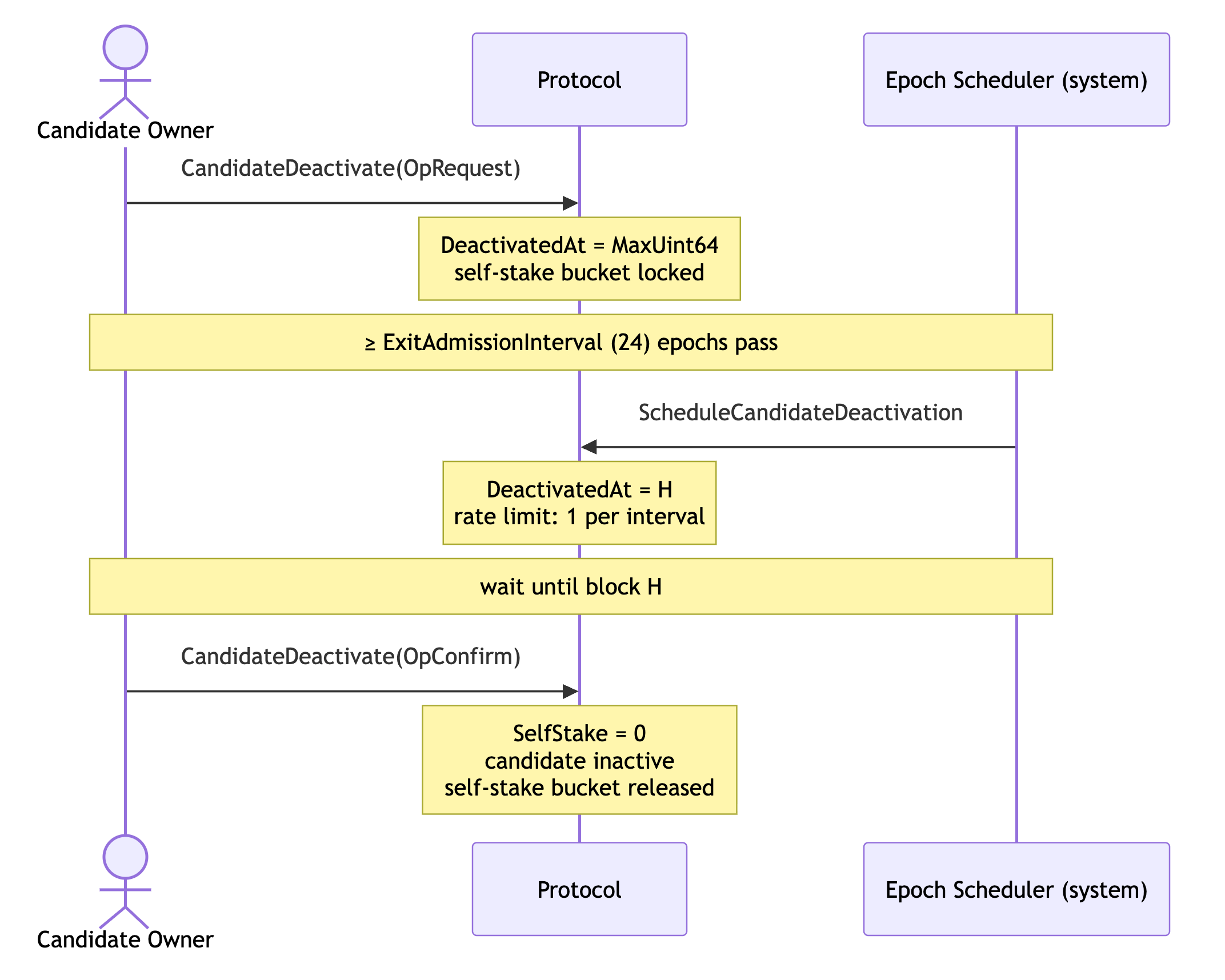
Stage 1 — Request
Triggered by: Candidate owner calls CandidateDeactivate(OpRequest).
Preconditions:
- Caller is the candidate owner.
- Candidate has a self-stake bucket (
SelfStakeBucketIdx != MaxUint64). DeactivatedAt == 0(no pending exit).
State changes:
DeactivatedAtis set toMaxUint64(sentinel for “requested, not yet scheduled”).- The self-stake bucket is locked; it cannot be unstaked until confirmation.
- Emits
CandidateDeactivationRequestedEvent.
Stage 2 — Schedule (system)
Triggered by: Protocol-generated ScheduleCandidateDeactivation at each epoch-start block.
Rate limit: At most one candidate is admitted per ExitAdmissionInterval epochs. The protocol stores _lastExitEpoch in state; if currentEpoch < _lastExitEpoch + ExitAdmissionInterval, no scheduling occurs this epoch.
When a candidate is admitted:
DeactivatedAt = blockHeight + ExitAdmissionInterval × NumBlocksPerEpoch(currentEpoch)
State changes:
DeactivatedAtupdated to the computed future height._lastExitEpochupdated tocurrentEpoch.- Emits
CandidateDeactivationScheduledEvent(identifier, scheduledHeight).
The self-stake bucket remains locked.
Stage 3 — Confirm
Triggered by: Candidate owner calls CandidateDeactivate(OpConfirm).
Preconditions:
DeactivatedAt != 0andDeactivatedAt != MaxUint64(i.e., scheduled).currentBlockHeight >= DeactivatedAt.- Caller is the candidate owner.
State changes:
SelfStakeset to 0.SelfStakeBucketIdxset toMaxUint64(cleared).- Vote weight recalculated without the self-stake multiplier.
- Candidate becomes inactive.
- The former self-stake bucket is converted to a regular vote bucket and becomes withdrawable.
- Emits
CandidateDeactivatedEvent.
Parameters
| Parameter | Value | Description |
|---|---|---|
ExitAdmissionInterval |
24 epochs | Minimum epochs between two scheduled exits |
CandidateDeactivateBaseIntrinsicGas |
10,000 | Gas for both OpRequest and OpConfirm |
Validation Rules
| Condition | Error |
|---|---|
Feature disabled (NoCandidateExitQueue = true) |
Action rejected |
DeactivatedAt != 0 on OpRequest |
ErrExitAlreadyRequested |
DeactivatedAt == 0 on OpConfirm |
ErrExitNotRequested |
DeactivatedAt == MaxUint64 on OpConfirm |
ErrExitNotScheduled |
currentHeight < DeactivatedAt on OpConfirm |
ErrExitNotReady |
| Unstake attempt while exit pending | Rejected with ErrUnstakeBeforeMaturity |
Feature Activation
This feature is gated by the NoCandidateExitQueue feature flag. When NoCandidateExitQueue = false (i.e., the flag is cleared), the exit queue is active. This flag is cleared at YapBlockHeight.
Rationale
Rate Limiting at the Epoch Boundary
Scanning for pending exits and admitting at most one per ExitAdmissionInterval ensures a bounded, predictable exit rate. Doing this at the epoch boundary (rather than per block) aligns with the existing epoch-based staking and election mechanics.
Using MaxUint64 as the Pending Sentinel
DeactivatedAt = MaxUint64 cleanly distinguishes “requested but not scheduled” from both “not requested” (0) and “scheduled at a specific height” (any concrete block number). This avoids a separate boolean field and keeps state changes atomic.
Request Is Non-Cancellable
Once an exit is requested, it cannot be cancelled. This prevents griefing patterns where a candidate repeatedly requests and cancels exits to manipulate network perception or trigger scheduling slots for other actors. It also simplifies the state machine.
Locking the Self-Stake Bucket
Locking the self-stake bucket from request through confirmation prevents a candidate from requesting exit while simultaneously withdrawing self-stake, which would undermine the notice period’s purpose. After confirmation, the bucket reverts to a regular vote bucket and is subject to normal withdrawal rules.
Backwards Compatibility
This IIP is NOT backwards compatible and requires a hard fork (activated at YapBlockHeight).
Breaking changes:
-
CandidateDeactivatesemantics changed: The action now requires the newopfield. Clients that issueCandidateDeactivatewithout specifyingopwill default toOpRequest; immediate deactivation is no longer possible. -
New system action:
ScheduleCandidateDeactivationis a new action type not present in previous protocol versions. Nodes running older software will not recognize it. -
Candidate state schema change: The
DeactivatedAtfield is added to the candidate record. Older nodes cannot interpret the updated state layout. -
Self-stake bucket locking: Any candidate that has called
CandidateDeactivate(OpRequest)will have its self-stake bucket locked until confirmation. This is a new constraint not present previously.
Security Considerations
- Griefing via queue starvation: An adversary cannot occupy all queue slots indefinitely because the rate limit is one per
ExitAdmissionIntervalepochs and the request is non-cancellable — each slot is consumed by a genuine exit. - No front-running risk: The schedule timing (
DeactivatedAt) is deterministic and set by the protocol, not by the user, so there is no advantage in ordering or timing the confirm transaction. - Self-stake manipulation: The locking mechanism prevents withdrawing self-stake during the notice period, ensuring the candidate’s economic commitment remains visible to delegators throughout the exit process.
Test Cases
Test cases will be implemented in the e2etest/ package of iotex-core, covering:
- Happy-path: Request → Schedule → Confirm across epoch boundaries.
- Rate limit enforcement: Two candidates request exit in the same epoch; only one is scheduled per
ExitAdmissionInterval. - Unstake rejected while exit pending.
- OpConfirm rejected before
DeactivatedAtis reached. - Duplicate request rejected with
ErrExitAlreadyRequested. - Feature flag: All deactivation actions rejected when
NoCandidateExitQueue = true.
Copyright
Copyright and related rights waived via CC0.